
WOW - I've made another post (trying to catch up a little) so make sure you check the list so you do not miss anything.
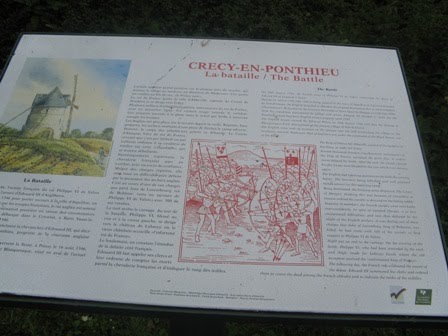
With Arras as our base for another night, we took off the next morning with a VERY busy agenda! The first two stops took me way back in time to the Hundred Years war and the Medieval period. The battle of Crecy was first on the list and the wind was howling cold and frigid. The battlefield is literally on the outskirts of a very small isolated town but we found it! There is a marker and a small medieval type wooden tower. From here we headed north to the battle field of Agincourt also in a small town but here the locals play upon the tourism and so have cut-outs of knights decorating some of the road. There is a a group of markers with a dated stelae fo the battle sight and a small map showing the layout of the battlefield. Here the French nights bogged down in the deep mud and were defeated by the English archers -- a key moment in history.
With Arras as our base for another night, we took off the next morning with a VERY busy agenda! The first two stops took me way back in time to the Hundred Years war and the Medieval period. The battle of Crecy was first on the list and the wind was howling cold and frigid. The battlefield is literally on the outskirts of a very small isolated town but we found it! There is a marker and a small medieval type wooden tower. From here we headed north to the battle field of Agincourt also in a small town but here the locals play upon the tourism and so have cut-outs of knights decorating some of the road. There is a a group of markers with a dated stelae fo the battle sight and a small map showing the layout of the battlefield. Here the French nights bogged down in the deep mud and were defeated by the English archers -- a key moment in history.


Now I drove north toward Belgium and key battle areas of World War I around the town of Ypres (Iepres). In each little French or Belgium town along the way we saw WWI war memorials with the names of those lost from the town and usually on the opposite side had been added a plaque with the names from WWII. As we drove north into what had been an area of very heavy fighting in WWI, the cemeteries multiplied. My mind raced back in time as I tried to imagine the devestated landscape from the awful artillery bombardments and the trenches; today the land is all farms and wild poppies. Yes, the fields of Flanders are filled with red poppies and it is gorgeous; the poppy is the symbol of the British remembrance of the war and on every WWI cemetery there have been left red poppies and plastic red poppy wreaths as commemorations.

The first site I knew we had to visit was the area that was fought over by the Canadians just north of Arras around the town of Loos. Here the Canadian government has established a national historic park and remembrance for all the young men who never returned home. The park contains a reconstructed trench and the well preserved landscape still undulates from the destruction of the pounding artillery and much of the area is still off limits because of unexploded shells. There are also extended tunnels running through the area. This area is known as Vimy Ridge and here the Canadians scaled and held the high ground at great cost and here they have built their national memorial of WWI It is a site to behold and no picture can really do it justice in terms of size. You can see it for many miles as you approach as it peaks above the woods. On it are inscribed the names of over 11,000 Canadians who were killed but whose remains were never identified. The magnificent structure sits at the very top of the highest point. On this day we would see 2 major memorials with thousands of names of those unidentified. Keep in mind that at the end of these horrible battles the land would be strewn with destroyed bodies, many just in pieces and with no means to identify them. The ground was chewed up and no living thing -- man or plant remained. Today all of the forested areas grew AFTER the war. On most of the memorial/cemetery sites they have historical photos that show the level of destruction and it is a site to behold as your mind tries to wrap around what you are seeing today.


 Keep in mind as you view the first picture here of Vimy Ridge that the flags are straight out -- good for a photo, not good for people! The wind was blowing at probably around 40 mph and up on the memorial we felt like human kites; to see the front side of the memorial, you must walk up and over and then down the other side. The last photo above is from the front side of the memorial and depicts all those who were lost. We almost froze to death or blew away and tried to imagine how those young men must have felt living here for months. And yet just a few hundred feet away we watched the sheep grazing in the cleared fields.
  Soon I was back driving north toward Ypres and along the way we detoured to find a most unusual British cemetery - one of only two of this type. It is a crater cemetery. The crater was created by a German mine under the British position. In WWI during the trench stalemate, each side tried to gain advantages and the British first introduced the use of coal miners to dig shafts under the German positions to place explosives. In this particular area, it was the Germans who were digging and they managed to explode an area under a British unit and killed over 40 men (this was actually a very small mine; one British mine instantly killed 5,000 Germans earlier in the war). Because the bodies were so badly damaged and entangled, the men were simply covered with dirt where they lay to create a cemetery and the names of the men in the unit were inscribed on the front wall of the cemetery. This cemetery simply sits on the side of a very small French farm road surrounded by fields of grain.
  As we continued our drive, we finally found a German WWI cemetery; it was very large and as usual quite subdued. Also there were few signs to guide us to its location. The site is very very large with around 40,000 graves. Each cross contains two names on the front and two on the back. What also stands out are the Jewish soldiers as they have gravestones instead of crosses; remember this was WWI and so not the persecution. But it is noticeble throughout the cemetery. The German cemeteries are maintained by a private non-profit group and German school children volunteer to go each year for a week to perform maintenance and upkeep -- there is no national governmental organization.
 Our next location to find was the Czechoslovak memorial. As we toodled down a small road at 90 kmp, we could see the flags flying on the next high spot in the road. Actually the Polish memorial is on one side and the Czech on the other. I pulled over and began to snap photos! The Czech memorial commemorates both WWI and WWII and includes a small cemetery. Again it is simply sits on the side of the road with a small pull-out and surrounded by farm fields. The cemetery is currently maintained by the British Commonwealth Graves commission.
 As we headed across northern France toward the Belgium border, I drove through many a small French town and the lovely round-a-bouts when suddenly I turned a corner and there was a French memorial to their war in Algeria in the 1950s. I swooped around and pulled onto the small side road to take photos. This was a very large memorial for such a small town and was built and maintained by the national government. A great surprise find! Again good wind for the flags in the pictures.
 We soon crossed into lovely Belgium where we also encountered numerous large farm equipment being driven down the roads and not in any hurry. In Europe because there really are no shoulders on many of the roads no one pulls over to let you pass so you just have to look for flat straight spots to get around them. Belgium farmers were all apparently going somewhere this day. Quickly we pulled into the small town of Ypres; today it is so quaint and beautiful but I knew from photos that the town had basically been completely destroyed in WWI as the British fought to hold this ground and suffered mightily. This ground was fought over for almost the entire war 1914-18 and the casualties were extremely high. At one point in 1916 the Germans introduced the use of poison gase at Passchendaele just on the northern outskirts. As the British sought to commemorate and remember their fallen, this was one place they were determined to build a mighty memorial....and they did. The Menin Gate was built at a key point of fighting in the town and on it are inscribed the names of over 54,000 British/Commonwealth soldiers who died but whose remains were never identified. Keep in mind this is JUST those whose bodieswere unaccounted for individually NOT the total of killed fighting here! This number is just slightly less than ALL of the US troops lost in the ENTIRE Vietnam War!!
 The gate is extremely impressive and again pictures cannot give a feel for the size and magnitude of it. Standing and peering up at all the names is just mind boggling after a short time; it seeps into you that these men were forever lost and yet they live on through this memorial and that with the flowers and such left behind they have not been forgotten. 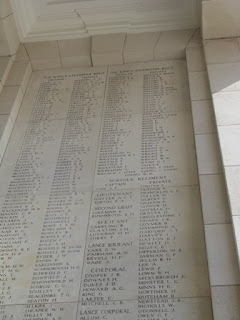


The town also contains a beautiful little memorial chapel built by the British which contains memorial plaques or seat cushions for every unit that fought in the Ypres salient during the war. It is a moving tribute.

As we walked through the darling town of Ypres, we spotted a Belgium Finest Chocolate store and well of course we went in to buy some souvenoirs! The staff were most kind and helpful.


 Our day was not over yet however. Near town was located an Australian 1st Army memorial and we set out to find it. Suzanne's mother is from Australia and this was particularly meaningful for her (like the Czech one was for me earlier in the day and goodness knows I had drug her to quite a few stops that day). Now this memorial became a challenge because we did not have a street name or road number and after circling the area it should have been located a few times, we zoomed in the GPS system for individual streets and managed to actually find a street sign! We turned down a one lane road and drove around hair pin turns; a few Belgiums out walking gave us strange looks but we continued our quest. Soon we spotted an obelisk poking out through a large stand of trees and after a few more sharp turns, we found our pull out on the road (a very small one) and there was a British cemetery to the right and then to the left in the middle of the stand of tall trees was a mound upon which was this large 20 foot tall obelisk. We walked through the mowed lane among the trees to the mound; we had found it! The pictures and descriptions were really awe-inspiring as this had been a defensive position held by the Australian 1st Army with a series of trenches and the entire area had been pulverized during the fighting. Now it is lush and green and the obelisk on the mound stands guard over a gorgeous cemetery containing many remains of the brave Australian troops. Bright beautiful red roses bloomed on the graves. The site is breath-taking and moving.
 With this quest completed, we decided to head towards Waterloo before returning to Arras. So off we went across parts of Belgium as we remembered that this was the anniversary of the battle! We arrived near 9:30pm but with still plenty of light. We walked along the path to look out over the landscape of one of the key moments in history! And the mound with the lion on top which commemorates and symbolizes the victory of Wellington over the mighty Napoleon commands the field. We gazed across time and history and imagined the soldiers and smoke from artillery as Europe was changed. 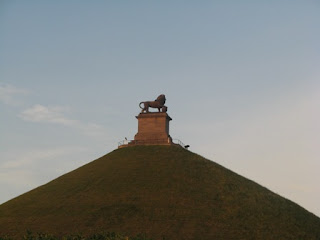


Travelling from the Middle Ages to WWI to the 19th century had build up our appetites and so we stopped in Waterloo for a bite and found a lovely Italian restaurant. The staff were all watching the World Cup games which dominate the evenings right now in Europe but we had good food and nice service. We then headed back into France and our hotel in Arras. We arrived to find that they had moved us to a different room and thus moved our stuff while we were gone. We were NOT happy and chewed on the night desk clerk (it was about midnight) who pretended to know little English. In our new room, we discovered all was fine but it was not what we had expected. Our day had been full and we had seen so very much across two countries and many a small town and we had been moved by it all.


